

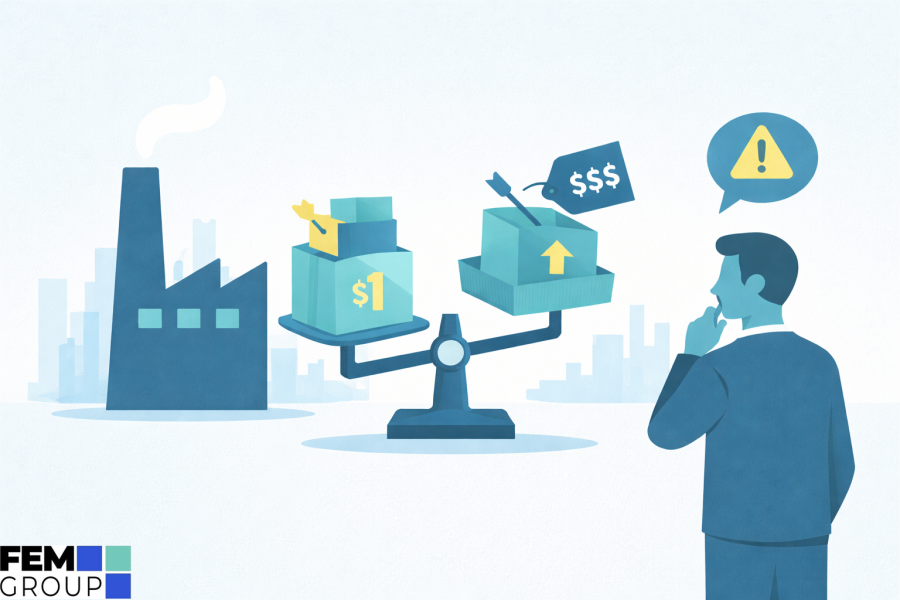
The industrial supplier paradox: when the cheapest ends up being the most expensive
After a budget closure, many industrial companies share a similar feeling: tight numbers, line items reviewed down to the last detail, and growing pressure to optimise costs. It is in this context that one idea gains strength in purchasing processes: “we need to lower prices”.
Reducing costs is logical. Necessary, even. The problem arises when price stops being a variable and becomes the decision itself. At that point, a well-known paradox appears in industry: the cheapest supplier on paper ends up being, over time, the most expensive.
Price as a mental shortcut
In complex environments, price often works as a shortcut. It is a clear, comparable figure, easy to justify internally. It allows decisions to be closed quickly and creates an immediate sense of efficiency: we have saved money.
However, in industry you rarely buy an isolated product. You buy equipment that must be integrated into a process, a service that must respond when something fails, a supplier that will have a direct impact on operational continuity.
Reducing a complex decision to a single number often oversimplifies reality.
When saving today creates costs tomorrow
The main problem with deciding solely on price is that many costs do not appear in the initial budget. They arise later, when the supplier is already in place and the project is underway.
Unplanned downtime, slow response times, communication errors, lack of technical support, the need for rework or constant adjustments. Each of these elements has a real cost, even if it does not immediately show up on an invoice.
In production, one hour of downtime can cost far more than the initial difference between two quotes. And yet, that risk is rarely weighed as heavily as the purchase price.
Visible costs are negotiated; invisible costs are suffered.
Technical support: when it stops being an “extra”
In many purchasing processes, technical support is seen as an add-on. Something desirable, but dispensable if the price is low enough. Until it is needed.
When a problem appears —and in industry it always does sooner or later— the difference between a supplier who responds and one who does not becomes clear. Not only because of the technical solution, but because of speed, clarity in communication and the ability to take responsibility.
At that moment, the initial price stops mattering. What matters is who is on the other end of the phone, who understands the process and who can act without creating further problems.
The value of a supplier is not measured when everything works, but when something fails.
Rework, adjustments and internal wear
Another common invisible cost is rework. Solutions that do not quite fit, installations that require constant adjustments, processes that need improvised corrections.
These issues do not only generate financial costs. They also cause internal wear. Technical teams spending time fixing others’ mistakes, managers having to justify incidents, departments losing focus on truly strategic tasks.
In the long term, this wear affects efficiency, internal climate and the perception of control over processes.
One-off purchasing versus long-term relationships
Many industrial purchasing decisions are approached as one-off transactions: something is needed, it is bought, and work continues. But the reality is that most industrial suppliers are not involved at just one moment, but accompany companies for years.
Equipment that requires maintenance, services that evolve, processes that are adjusted over time. In this context, the relationship matters as much as the product.
A supplier who understands the business, knows the client’s history and is committed for the long term provides value that is difficult to quantify, but very real. And that value rarely matches the cheapest offer.
The mistake of confusing negotiation with pressure
Negotiation is a natural part of any purchasing process. Applying pressure solely on price is not always so. In some cases, constant pressure damages the relationship from the outset.
When the message is “whoever lowers the most wins”, a clear signal is sent: the supplier is interchangeable. This often translates into less commitment, less flexibility and less willingness to make extra efforts when problems arise.
A relationship based only on price tends to generate responses at the same level.
What is really evaluated when problems arise
It is interesting to see how evaluation criteria change when a serious issue appears. At that point, the questions are no longer about price:
Who takes responsibility?
Who takes responsibility?
Who provides solutions instead of excuses?
Who provides solutions instead of excuses?
These questions are rarely asked during the purchasing phase, but they end up being decisive in the real experience with the supplier.
And when the answer is unsatisfactory, the cost is no longer just financial. It is operational, reputational and, in some cases, personal.
The budget closure context
After closing budgets, it is common to review past decisions and adjust future criteria. It is a good moment to ask not only how much was paid, but what each decision really cost.
Which suppliers were up to the task, which generated more incidents, where savings were real and where initial savings ended up being expensive.
This exercise is not about assigning blame, but about learning. Because in industry, repeating mistakes is usually far more expensive than recognising them in time.
Price matters, but it does not decide alone
All of this does not mean that price is unimportant. It is. But it should occupy its rightful place: one variable among many others.
Deadlines, reliability, support, experience, responsiveness, sector knowledge, human relationship. All of these factors directly influence the final outcome, even if they do not always appear in the initial quote.
Choosing a supplier is not choosing a number; it is choosing a way of working.
A necessary reflection
Perhaps the paradox is not that the cheapest supplier ends up being the most expensive, but that we are still surprised when it happens. Industry has shown time and again that decisions based solely on price rarely work well in the medium term.
The question is not whether less can be paid, but what is really obtained in exchange for that saving.
👉 In your experience, how many times has a price-based decision generated hidden costs later on?
👉 What weight do relationship and support have today compared to price in your purchasing processes?
As with almost everything in the industrial environment, there is no universal answer. But taking time to review these decisions after a budget closure can be a good starting point for buying better, not just cheaper.