How Would Your Company Look If You Started It Again Today?
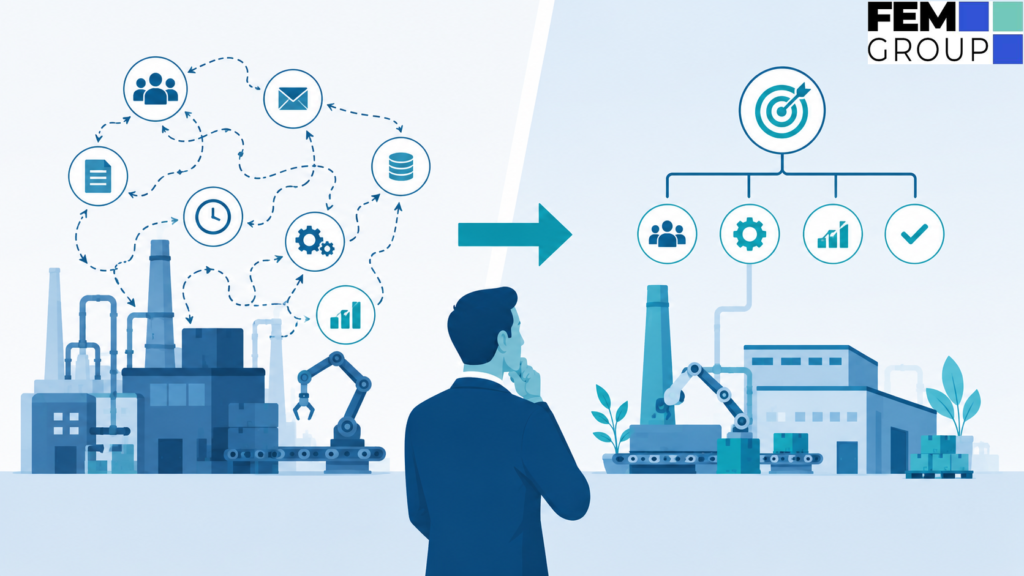
Imagine for a moment that tomorrow you had the opportunity to create exactly the same company you run today. The same products, the same customers, the same market and virtually the same resources. The only difference is that you are starting from scratch, with all the experience you have gained over the past few years.
The question is simple, but uncomfortable: would you organize it exactly the same way?
Probably not.
And that answer says far more about the company than it might seem at first glance.
Experience changes the way we understand organizations.
The problem is that we rarely redesign the company based on everything we have already learned.
The Weight of Decisions That Are Never Reviewed
Every company is the result of thousands of decisions made at very different moments. Some were strategic. Others responded to a specific urgency. Many simply seemed like the best option available at the time.
A department was created because the workload required it.
A manager was hired to cover a specific need.
A procedure was established to solve a recurring issue.
An additional control was added to prevent an error.
Over time, all these decisions gradually shaped the organization we have today.
What now appears to be a logical structure is often the sum of historical decisions.
Not everything that exists was deliberately designed; many things simply emerged over time.
And once they become part of the company’s daily operation, they are almost never questioned again.
Companies Evolve... But Their Design Doesn't Always Do the Same
Markets change. Customers change. Technology changes. Even the people who make up the organization change.
However, many companies continue to operate with structures that were designed for a reality that no longer exists.
Departments created ten years ago.
Processes designed for a completely different production volume.
Responsibilities that have expanded without ever being redefined.
Approval workflows that made sense when the company was much smaller.
The company evolves constantly.
The organization often remains anchored to decisions made in the past.
And the greater the gap between today’s company and the company for which the structure was originally designed, the more small inefficiencies begin to appear and eventually become normalized.
The "We've Always Done It This Way" Effect
If there is one phrase capable of stopping almost any organizational review, it is probably this one.
“We’ve always done it this way.”
It is rarely said with bad intentions. On the contrary, it often reflects stability, experience or continuity.
But it can also become an obstacle to rethinking important aspects of the business.
Why does this report have to go through four people?
Why does this department report to another one instead of directly to management?
Why does this approval require three signatures?
Why do these meetings still follow exactly the same format?
In many cases, nobody even remembers the original reason.
They simply continue because they have been part of the company’s routine for years.
Habit provides stability.
But it can also hide improvement opportunities that nobody questions anymore.
Starting from Scratch Forces You to Justify Everything
This thought experiment has something particularly interesting about it: it removes the weight of history.
If you were creating your company today from the beginning, you would have to justify every organizational decision.
Why do these departments exist?
Why does this process have these steps?
Why does this information flow this way?
Why are these responsibilities distributed like this?
Suddenly, many answers would stop being “because we’ve always done it this way” and become genuine design decisions.
Once history disappears, only the reasons remain.
And not every current organizational structure can withstand that exercise of review.
Organizational Inertia Is Also Part of the Company
Every company develops inertia.
These are not written procedures or official rules, yet they strongly influence the way people work.
There are people who are always consulted.
Decisions that always follow the same path.
Problems that always end up in the same department.
Changes that nobody promotes because “it already works.”
These dynamics do not appear on any organizational chart, yet they influence the company just as much as any formal procedure.
Organizations do not operate only through what is formally defined.
They also operate through habits that have become established over the years.
And that is precisely why they are so difficult to detect from within.
Would You Really Keep the Same Processes?
One of the most interesting questions raised by this exercise concerns processes.
Not how they should work, but how you would design them if you were starting today.
Would exactly the same approval steps still exist?
The same controls?
The same communication flows?
The same authorizations?
It is possible that many of them would still make perfect sense.
But others would probably disappear, be simplified or even be completely redesigned.
Not every old process is a bad one.
But every process should be open to review.
Because a process that was excellent ten years ago may no longer be the most appropriate one for today’s reality.
People Also Shape the Design
Another interesting aspect is that many companies have gradually adapted their structure around the people who work there.
Not around the functions themselves.
Over time, responsibilities are created for specific individuals, tasks are distributed according to personal affinities and organizational decisions respond more to who does what than to how the system should actually operate.
This is completely natural.
But it also means that the company evolves around its own history rather than around the best possible organizational design.
Designing around people is inevitable.
Designing only around people can limit the organization’s evolution.
The Difference Between Building and Accumulating
There is an important difference between building an organization and simply accumulating organizational elements.
Building means designing with a clear logic.
Accumulating means adding procedures, meetings, controls, managers or reports every time a new need arises.
Over the years, many companies end up accumulating far more than they actually build.
Nothing seems particularly unnecessary on its own.
But the overall result becomes far more complex than it really needs to be.
Every individual change may make sense.
The problem begins when nobody reviews the organization as a whole.
The Advantage of Looking at the Company with Fresh Eyes
One of the greatest benefits of this exercise is not to change the company immediately.
It is to observe it from a different perspective.
When we stop thinking about how the company got here and begin asking ourselves how we would design it today, different questions start to emerge.
Why are we still doing this?
What would we eliminate?
What would we simplify?
What would we design differently?
Very often, the answers do not require major transformations.
Sometimes it is enough to identify small decisions that have gone unquestioned for years.
Changing the way we look at the organization is often the first step toward changing it.
The best improvements often begin with a good question.
A Final Reflection
Very few companies ever have the opportunity to start completely from scratch.
But every company can make the exercise of imagining it.
Because the objective is not to question everything that has been built, but to discover which parts of the current design still respond to today’s needs and which parts continue to exist simply because of inertia.
Organizations rarely become complex overnight.
They become complex little by little, decision after decision, year after year.
And for that very reason, they can also become simpler in exactly the same way: by reviewing what has been accepted as valid for far too long without ever asking again why it exists.
The best organization is not always the one that has grown the most.
More often, it is the one that dares to redesign itself using everything it has learned.
👉 If tomorrow you had to build your company from scratch, would you keep exactly the same organizational structure?
👉 Which processes, meetings, responsibilities or ways of working would you redesign based on the experience you have today?
Because sometimes, the greatest opportunity for improvement is not about adding something new.
It is about having the courage to look at your current company as if you were building it for the very first time.