

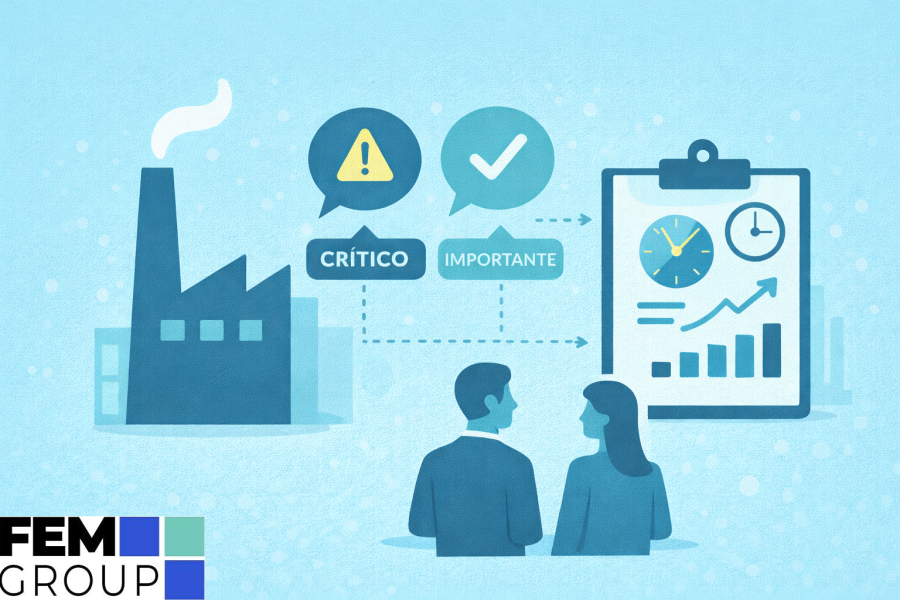
When urgency is not real: learning to distinguish what is critical from what is important in industry
In many industrial companies there is a constant sense of urgency. Everything seems to be a priority, everything requires an immediate response, everything “cannot wait”. Day-to-day work becomes a succession of problems to solve, calls to answer and decisions to make quickly. However, not everything that is urgent is truly critical. And not everything that is critical comes with haste.
This confusion between urgency and importance is not a minor detail. It is one of the factors that most strongly shapes how industrial companies make decisions, allocate resources and plan their future.
Living in firefighting mode is not always moving forward
Industry is demanding by nature. Complex processes, critical machinery, tight deadlines, customers who depend on operational continuity. In that context, reacting quickly is often necessary. The problem arises when constant reaction replaces reflection, and urgency becomes the only criterion for decision-making.
When everything is treated as an emergency, the ability to prioritise is lost. What makes the most noise is addressed first, not necessarily what has the greatest impact. And little by little, what is important —strategic maintenance, process reviews, supplier analysis, investment planning— is pushed aside because “now is not the time”.
The risk is not in solving urgent issues, but in living permanently within them.
Operational urgency vs. strategic urgency
Not all urgencies are the same. In the industrial environment, at least two very different types coexist:
- Operational urgency: when something stops, fails or threatens to do so.
- Strategic urgency: related to decisions that, if not taken in time, generate problems in the medium and long term.
The first is usually obvious and visible. The second is silent. And precisely for that reason, it is often ignored.
A piece of equipment that stops forces action. An inefficient process that “sort of works” can remain unchanged for years. A supplier that barely meets expectations does not trigger immediate alarms, but may be undermining competitiveness without anyone noticing.
Industry responds very well to visible urgencies, but tends to postpone strategic ones.
When urgency becomes normalised
One of the biggest problems appears when urgency stops being exceptional and becomes routine. Phrases such as “we’re always tight”, “everything here runs fast”, “there’s no time to stop and think” end up becoming part of the internal culture.
In that context, making rushed decisions stops being seen as a risk and becomes normal. Temporary solutions are accepted and turn permanent. Technical decisions are made without proper analysis. “What’s available now” is chosen instead of “what is appropriate”.
And most dangerously: people stop questioning whether that urgency is real or simply inherited.
The invisible cost of always deciding fast
Deciding quickly is not free. Although it may seem effective in the short term, in the medium term it usually generates costs that are hard to quantify:
Poorly sized processes that are difficult to correct later.
Equipment or suppliers chosen for availability, not suitability.
Lack of alignment between departments.
Technical solutions that fix the immediate problem but create new ones.
These costs do not always appear on a specific invoice, but they show up as inefficiencies, rework, recurring stoppages or internal wear and tear.
Haste is rarely accounted for as a cost, but it almost always ends up being paid.
What is important rarely shouts
One reason why important matters are postponed is that they rarely appear as emergencies. Reviewing a process that works “more or less”, rethinking a maintenance strategy or analysing a supplier relationship in depth does not create immediate urgency.
There is no alarm going off. There is no stoppage forcing action. And so, it gets postponed.
However, many of the decisions that truly make a difference in industry do not arise from a crisis, but from conscious review. They are made when someone stops, analyses data, compares options and thinks beyond the short term.
What is important usually requires time, context and calm. Exactly what constant urgency eliminates.
The time of year also matters
It is no coincidence that this reflection becomes especially relevant at certain times of the year. There are periods —such as the start of the financial year, the close of a quarter or the return after technical shutdowns— when operational load increases and the sense of urgency intensifies.
Precisely in those moments, distinguishing between what is critical and what is merely urgent becomes essential. Not to slow activity down, but to prevent day-to-day pace from dragging along decisions that should be taken with a different mindset.
Industry cannot afford to stop, but it also cannot afford to always decide without perspective.
Stopping to think is not a waste of time
There is a widespread belief in industrial environments: stopping equals inefficiency. Thinking, reviewing or analysing is sometimes seen as unproductive time compared to action.
However, planning is not the opposite of execution; it is a way to execute better.
Companies that manage to distinguish between real urgency and strategic importance are not usually the ones that work less, but the ones that work with more planification.
Learning to prioritise is not easy, but it is necessary
Distinguishing what is critical from what is important is not a theoretical exercise. It requires experience, data, dialogue between departments and, in many cases, external support. It also requires accepting that not everything can be solved at once and that some decisions need time to mature.
The goal is not to eliminate urgency —because it will always exist in industry— but to prevent the urgent from monopolising all decisions.
When everything is urgent, nothing is truly a priority.
An open reflection
Perhaps the key question is not how many urgencies an industrial company manages, but how many of them are unavoidable and how many have become normalised over time.
Stopping to review that difference can mark the beginning of more solid, more efficient and more business-aligned decisions.
👉 In your company, is there a clear distinction between what is urgent and what is important?
👉 What strategic decisions are being postponed because “now is not the time”?
As is often the case in industry, the answers are not universal. They depend on context, sector and internal culture. But identifying which urgencies are real and which are not is often a good first step towards better decision-making.