The Mistake of Designing a Company Around People Instead of Processes
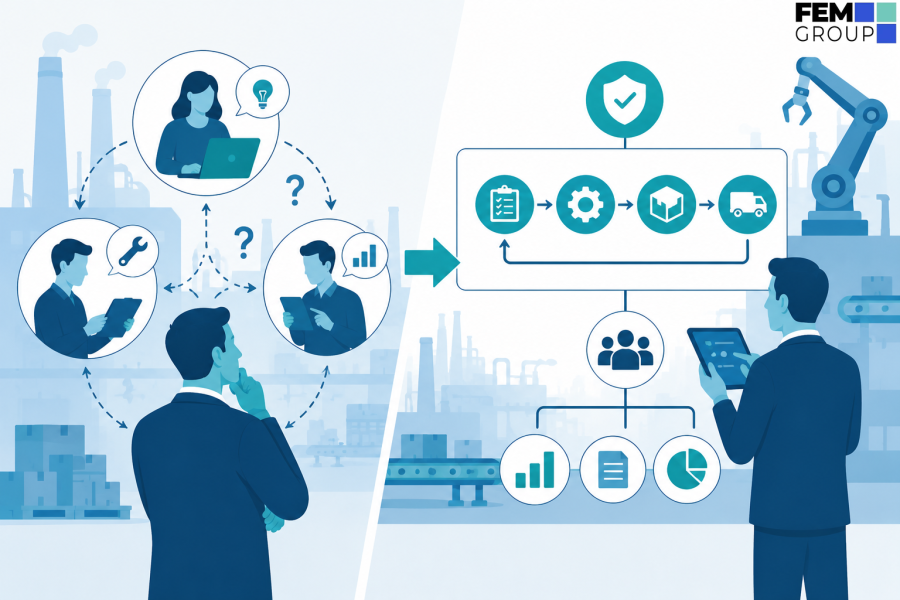
In many industrial companies, the real structure is not defined by organizational charts or procedures, but by specific individuals. It is not uncommon to hear phrases such as “John handles that,” “Marta knows that,” or “Without Peter, this won’t get done.” At first glance, this may seem like a natural form of organization based on experience, but in reality, it is a clear sign of a deeper problem: the company is not designed around processes, but around individuals.
When a company depends on people, it is not structured: it is supported.
Knowledge is not inside the system; it is inside people.
This approach may work for a while, especially in small companies or during the early stages of growth. But as the organization evolves, this way of operating becomes a structural limitation.
When People Replace Processes
The first sign of this problem appears when responsibilities are not clearly defined by processes, but by names. Instead of having a structured workflow, there is a network of informal “owners” of knowledge and execution.
This means that the system is not sustained by clear rules, but by the availability and judgment of certain individuals.
There are no defined processes; there are people who are responsible by habit.
The real structure is informal, even if it is not recognized as such.
The problem is not having competent people. The problem is that the organization depends on their constant presence to function properly.
The False Efficiency of “It Works Better This Way”
In many cases, this model is justified internally with a seemingly logical idea: “if this person does it, it works better.” And it is true that individual experience can improve efficiency in specific tasks.
But the problem arises when that individual improvement replaces the creation of a repeatable system.
Individual efficiency cannot replace organizational efficiency.
What works with one person does not necessarily work as a system.
This approach creates a paradox: the company may appear more efficient in the short term but less stable in the long term. Everything depends on maintaining a specific combination of people and knowledge.
Growth Exposes the Fragility
While a company is small, designing around people may seem practical. Everything is more direct, communication is fluid, and complexity is limited. But as the organization grows, this model begins to reveal its weaknesses.
Teams, projects, shifts, customers, and points of contact increase. What was once resolved informally starts generating inconsistencies.
Growth does not create the problem; it simply makes it visible.
What was manageable becomes dependent.
At this point, the company discovers that it cannot scale without duplicating key individuals or creating bottlenecks around them.
Nonexistent Processes or Invisible Processes
One of the most common effects of this model is the absence of clear processes or the existence of “invisible” processes. In other words, there is a way of doing things, but it is neither documented nor standardized.
Each person may be performing similar tasks in slightly different ways, based on experience, judgment, or habit.
The process exists in practice, but not within the organization.
Standardization is implicit, not explicit.
This creates operational variability, makes onboarding new employees more difficult, and increases dependence on those who already master the system.
The Difficulty of Transferring Knowledge
When a company is designed around people, transferring knowledge becomes complex. Not because people are unwilling to share it, but because that knowledge is not structured in a way that can be easily transferred.
Much of that expertise exists in daily practice, accumulated experience, and decisions made in specific contexts.
Tacit knowledge is not easily transferred.
Without processes, learning depends on proximity to experience.
This creates constant dependence on informal learning, which is slow, inconsistent, and difficult to scale.
The Hidden Risk of Replacement
One of the moments when this problem becomes critical is when a key person leaves the organization. It does not have to be a dramatic departure; it could be retirement, an internal move, or a prolonged absence.
At that moment, the company loses not only a person but part of its actual operating system.
When a person leaves, part of the process leaves with them.
Continuity depends on what was never documented.
And most often, the replacement cannot replicate exactly the same way of working, creating adjustments, delays, and loss of efficiency.
The Mistake of Confusing Experience with Design
One of the most significant conceptual mistakes in this type of organization is assuming that individual experience can replace organizational design.
Experience is essential, but it cannot be the sole support of the system. A well-structured company does not eliminate experience; it integrates it into processes that allow knowledge to be transferred and scaled.
Experience improves the system, but it cannot be the system.
Organizational design is what guarantees continuity.
When this is not understood, the company grows on fragile foundations.
When Everything Depends on Exceptions
In companies designed around people, it is common for much of the operation to function through exceptions. Instead of following a standard flow, situations are handled case by case.
This may provide flexibility in the short term, but it creates a lack of structural consistency.
If everything is an exception, there is no real standard.
Operations become a collection of individual decisions.
Over time, this complicates management, training, and continuous improvement.
The Impact on Decision-Making
When a company depends on people instead of processes, decision-making is also affected. Many decisions are not based on organizational criteria but on who has the information or experience at that moment.
This can generate inconsistencies, informal hierarchical dependence, and a lack of clarity in responsibilities.
Decisions do not follow the system; they follow people.
The organization loses consistency in the way it operates.
And when this happens repeatedly, the structure ceases to be predictable.
Designing Processes Is Not Bureaucratizing
One of the most common objections to this approach is the idea that designing processes introduces bureaucracy or rigidity. In reality, the opposite is true.
A good process does not limit flexibility; it makes flexibility possible without losing control.
Defining how things are done does not mean eliminating judgment; it means ensuring that judgment is not the only basis for operation.
The process does not replace the person; it frees them.
Structure allows knowledge to stop depending on specific individuals.
A Final Reflection
Designing a company around people is understandable, especially in industrial environments where experience is critical. But in the long term, this approach has a clear limit: the company grows only as far as its key people grow.
The true leap in organizational maturity occurs when knowledge stops being individual and becomes structural.
A company does not scale through its people; it scales through its processes.
Organizational design is what determines its real growth capacity.
👉 The question is not who knows how to do it today, but whether the company would still know how to do it tomorrow without those people.