The Company You Think You Have and the Company That Actually Exists
In many industrial companies, there is a fairly defined image of how the organization works. Managers believe they understand the processes, department heads have a clear view of their teams, and the general feeling is that the structure responds in a predictable and controlled way.
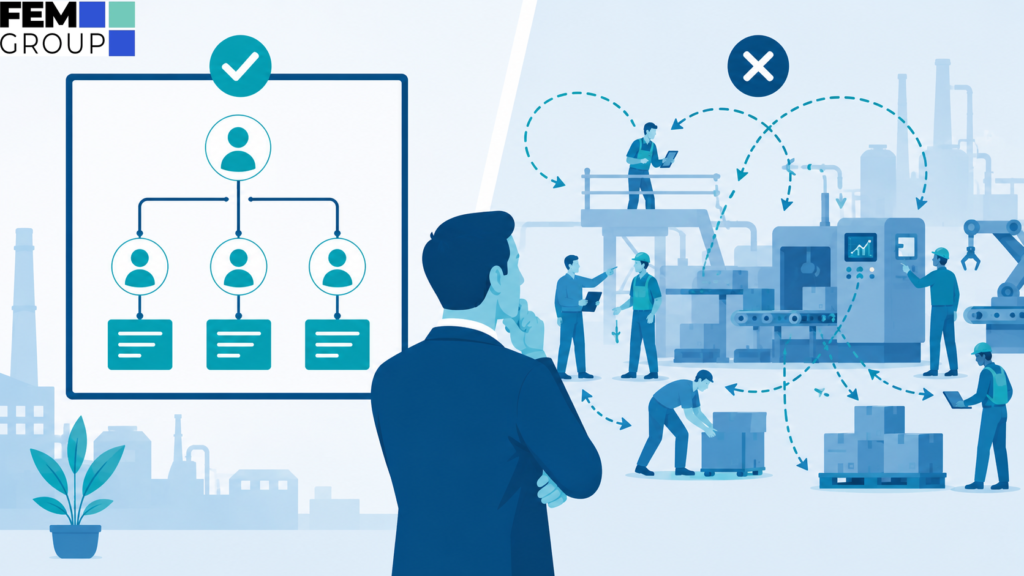
However, there is an important difference between the company that appears in organizational charts, procedures, and management meetings, and the company that actually operates every day.
The company we think we have does not always match the one that exists.
There is often more distance between perception and operational reality than it seems.
And the greater that distance becomes, the harder it is to make good decisions.
Reality Does Not Always Follow the Design
Every organization has a formal structure. There are defined responsibilities, documented processes, established workflows, and shared objectives.
But alongside it, there is usually an informal structure that rarely appears in any document.
People who act as links between departments. Decisions made through unofficial channels. Procedures that have been modified over time without being formally updated. Solutions that work thanks to tacit agreements between teams.
The formal organization explains how the company should operate.
The informal organization explains how it actually operates.
The problem appears when these two versions drift too far apart.
Metrics Do Not Always Tell the Whole Story
Many companies base their perception of reality on KPIs, reports, and dashboards. They are essential management tools, but they have an obvious limitation: they show results, but they do not always explain what is happening behind them.
Two companies may present similar indicators and yet operate in completely different ways.
One may rely on solid and stable processes. The other may be achieving results thanks to the extraordinary effort of certain individuals, improvised solutions, or a constant ability to put out fires.
Numbers show the outcome.
Operational reality lies in the path that leads to it.
And that path is not always visible through reports.
When Problems Are Not Visible
One of the greatest organizational risks is assuming that the absence of visible problems means everything is working properly.
Many inefficiencies remain hidden for years because someone compensates for them.
A manager who personally reviews everything before it is sent. A technician who corrects errors proactively. An administrator who detects failures before they reach the customer.
From the outside, the system appears to work perfectly.
But in reality, the system may depend on compensation mechanisms that nobody has formally identified.
Not all problems generate visible incidents.
Some survive for years because someone quietly absorbs them.
Management’s View and Operational Reality
As a company grows, a very common phenomenon appears: information starts to be filtered.
Not because of bad intentions, but simply because of organizational dynamics.
Each level interprets reality from its own perspective. Problems are simplified, incidents are summarized, and decisions are passed upward in increasingly condensed forms.
By the time information reaches management, it has often already passed through several filters.
Management makes decisions based on the reality it receives.
The problem arises when that reality does not fully match the one experienced by the teams.
The greater the distance between both perspectives, the harder it becomes to manage accurately.
Success Can Also Distort Perception
There is a widespread belief that organizational problems only appear when results are poor.
But reality is usually more complex.
Sometimes, the companies with the best results are precisely the ones that question certain aspects of their operations the least.
Sales grow.
Production moves forward.
Customers keep buying.
And this naturally creates a sense of confidence.
However, good results can hide structural weaknesses that have not yet been tested.
Success does not always prove that the system is solid.
Sometimes it simply means it has not yet been pushed to its limits.
Conversations That Never Reach the Surface
Every company has topics that are discussed in hallways, during shift changes, or among certain teams, but rarely appear in formal meetings.
Small inefficiencies.
Processes that create frustration.
Rules that nobody fully understands.
Tasks that are unnecessarily duplicated.
These conversations often contain an important part of the organizational reality.
Not because they are always right, but because they reveal how the company is perceived by those who live it every day.
The real culture of an organization is not discovered in presentations.
It is discovered by observing how people speak when nobody is evaluating them.
The Difference Between Functioning and Being Prepared
Many organizations function reasonably well under normal conditions.
The truly interesting question appears when conditions change.
What happens if the workload increases?
What happens if new key customers are added?
What happens if a key employee leaves the company?
What happens if a new plant is opened or operations are expanded?
It is at those moments that the difference emerges between a company that simply functions and one that is truly prepared.
Functioning today does not guarantee being prepared for tomorrow.
The strength of a system is measured when the context changes.
The Danger of Making Decisions Based on Incomplete Reality
All business decisions start from an interpretation of reality.
Investing.
Hiring.
Restructuring.
Automating.
Expanding.
Everything depends on how we understand the current situation.
If the image we have of the company does not reflect what is really happening, decisions can be technically correct and still produce disappointing results.
Not because the strategy is wrong, but because the initial diagnosis was incomplete.
The quality of a decision depends largely on the quality of the reality used to make it.
Managing based on inaccurate perceptions creates problems that are difficult to explain later.
The Importance of Looking Beyond the Obvious
The most mature organizations are not necessarily the ones with the fewest problems.
They are the ones that constantly challenge their own perceptions.
They review assumptions.
They compare information.
They analyze how work is actually carried out.
They look for differences between the designed process and the executed process.
They understand that operational reality is constantly evolving.
Organizational maturity does not mean assuming everything works well.
It means constantly checking whether reality still resembles what we believe it to be.
A Final Reflection
Every company has two versions of itself.
The one that appears in procedures, organizational charts, and reports.
And the one that actually exists every day in production, maintenance, logistics, quality, administration, or management.
Usually, they look similar.
The question is: how similar?
Because the greater the distance between them, the greater the risk of making decisions based on an incomplete picture.
The company you think you have shapes your decisions.
The company that actually exists shapes your results.
👉 To what extent does your organization’s view match what really happens day to day?
👉 What would you discover if you analyzed your processes as they are executed today, rather than as they were originally designed?
Because in many cases, the greatest challenge is not changing the company.
It is understanding precisely which company is actually standing in front of us.