
Industrial CRM: the strategic tool every company should consider
Introduction – The chaos we all know
This situation will likely be familiar to you: customer lists spread across different spreadsheets, emails lost in inboxes, calls nobody logged, and production orders arriving incomplete because there wasn’t a single source of information.
This disorder, which may seem minor, ends up generating wasted time, drops in productivity, and—worst of all—dissatisfied customers and uncoordinated production teams.
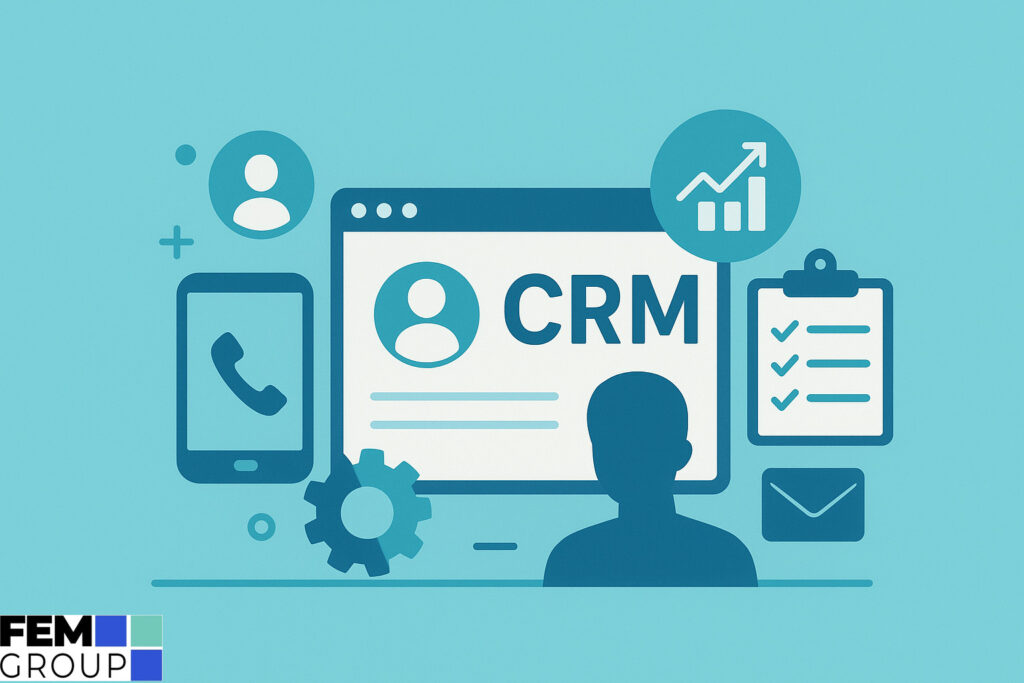
In this context, the Industrial CRM (Customer Relationship Management) emerges as a key tool to bring order, professionalize management, and move toward a more efficient organization.
What is an Industrial CRM (and what it is not)?
An industrial CRM is not just “another program” to add to your toolbox. It is, essentially, a work philosophy: centralizing all information related to customers, contacts, suppliers, and business opportunities and connecting them directly with production and logistics processes in one single system.
This allows anyone in the company—from sales to administration, production, or management—to access the data they need in real time. That way, they can better serve a customer, track an order, or plan manufacturing more realistically.
What an industrial CRM is not:
It is not just sales software.
It does not replace a solid commercial or production strategy.
It is not a magic wand that solves problems by itself.
Its value lies in its ability to connect teams and production, streamlining processes that, without that global vision, would remain fragmented.
Benefits of an Industrial CRM for any company
Although it’s often associated with large corporations, the truth is that an industrial CRM brings value to companies of any size. Its main benefits include:
Centralized information: all data in one place, accessible and updated.
Better internal collaboration: marketing, sales, administration, production, and management working on the same base.
Real-time data: orders, inventories, or production forecasts visible at any moment.
Automation of repetitive tasks: call reminders, email sending, production order creation, or automatic incident tracking.
Resource optimization: less time wasted looking for information, better production planning, fewer errors.
Better customer experience: faster, consistent responses, more reliable deliveries, and clear visibility of every order’s status.
In short: an industrial CRM not only organizes but also multiplies the ability to grow without operational complexity becoming a barrier.
Common mistakes when implementing an Industrial CRM
Many CRM implementations fail because of classic mistakes:
Thinking the CRM fixes everything. If internal processes are poorly defined, a CRM will only digitize that disorder.
Implementing it all at once without a plan. Jumping from zero to everything in a few weeks usually creates rejection and technical issues.
Not involving key users. If sales, administration, or production are not engaged in the setup, they’ll see it as imposed and resist using it.
Choosing by trend or price. The most expensive or popular CRM is not necessarily the best fit for your business.
Forgetting training. Without proper training, the CRM turns into software that “nobody knows how to use.”
Avoiding these mistakes is the first step to making the tool an ally instead of an obstacle.
How to choose the right Industrial CRM
This is where many companies get stuck: how to decide among so many available options? The key is to follow a clear roadmap:
Analyze the current situation: what problems do we want to solve? Where are the biggest losses of time, resources, or money?
Define priorities: not all goals are equally urgent; prioritization is key.
Identify needs by area: sales, administration, production, customer service, management.
Evaluate scalability and ease of use: think not only about today but also about future growth.
Compare solutions objectively: price, functionalities, integration with ERP and other tools.
Test with real cases: simulate day-to-day tasks, from registering an order to planning production.
Plan phased implementation: start small and scale up.
Ultimately, there’s no such thing as “the best CRM on the market.” There is the most suitable industrial CRM for your company, depending on its reality, its team, and its objectives.
Best practices for a successful implementation
Once chosen, the most delicate step is implementation. Some key recommendations are:
Define clear objectives: know what you want to achieve before starting.
Engage teams from the beginning: sales, administration, and production should feel part of the process.
Plan in phases: implement first in a critical area and then expand.
Measure results: set success indicators (time, costs, customer satisfaction, productivity).
Expert guidance: rely on someone who knows the methodology and can guide the process.
🔎 Practical example
Imagine an industrial machinery company with 25 employees managing everything through spreadsheets and scattered emails. The sales team spends hours updating sheets, administration receives incomplete orders, production has no clear visibility of ongoing work orders, and management lacks reliable data on sales and workloads.
After implementing an industrial CRM with a phased plan:
Sales reps log opportunities in real time from trade shows or technical visits.
Administration receives complete orders, with full traceability.
Production accesses updated order information and can better plan time, resources, and deliveries.
Management checks real-time dashboards on projects, sales, and production capacity.
Time spent on manual tasks drops by 40%.
The result was not “just new software,” but a change in the way of working: more order, more control, and greater team motivation.
FEM Group's approach
At FEM Group, we know every company is different. That’s why our approach is not about recommending the most popular CRM, but following a three-phase strategic process:
Strategic assessment: analyze how the company operates today and identify bottlenecks.
Realistic roadmap design: prioritize changes and plan phased objectives.
Gradual implementation with metrics: measure each step and ensure a positive impact.
Most importantly: we propose the most optimal CRM for you and guide you throughout the process.
If you wish, we can even share a comparative guide of industrial CRMs we use daily, classified by price, functionality, and ease of use.
Conclusion
A CRM is not a tech trend or unnecessary expense. It’s an investment in order, productivity, and sustainable growth.
👉At FEM Group, we not only analyze your processes, but we accompany you in choosing, implementing, and optimizing the industrial CRM best suited to your company, ensuring it becomes a growth lever and not just another software.
If your company is at the point where Excels no longer suffice, it might be time to take the leap.